
This article is about how experiential learning in nature enhances team building. Nature and awe are essential ingredients for us to thrive, and safety is essential for us to learn. This case study describes ways to include this in doing team development in nature.
Guest article by Dorchess de Koning.
In the way work is organised these days, we may have forgotten to listen to our bodies and to be in awe. An increasing number of publications from the field of neuroscience and experience design reveal that awe matters and how we experience the world shapes the way we work, live and relate.
By going through something awe-inspiring, we open up to learning, each other and our inner selves. Working together in wonder invites playfulness and an attitude of curiosity which helps to expand perspective. In experiencing something hands-on and reflecting on that experience, we learn on a deeper level than when we read a book, watch a tutorial, or listen to a presentation.
Awe is essential for thriving
In nature and art, there is a lot of awe. In the human body, there is so much to be in awe of. Humans are capable of sensing so much and being aware of what our bodies signal, helps us react to novel situations, learn and come up with creative solutions and collaborate. In order to keep stress levels low and achieve the goals we have set, it is important to set aside team time to engage in fun, learning and reflection.
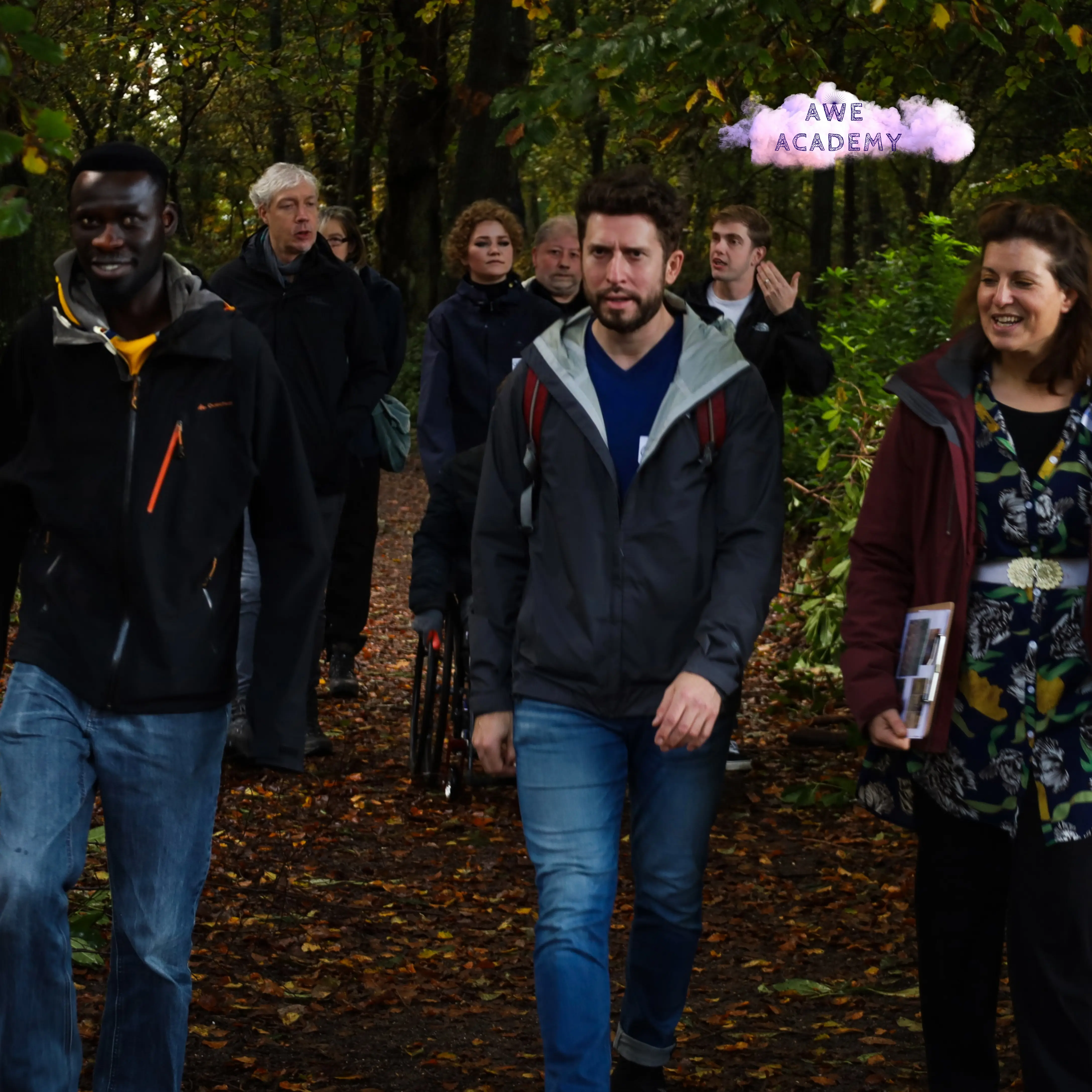
I take teams into nature (usually a nearby forest) for the great effects it has on the well-being of our species. Experiential outdoor learning is engaging, reduces stress, opens up the senses and is an inviting way for teams to step into a learning experience that offers more insight than an afternoon of drinks and bowling. The work we do behind laptops in offices unfortunately doesn’t always help teams to flourish. Team building in nature with awe, inspiring challenges and reflection does.
‘Practise what you preach’
Over the course of my own life, I have sought ways to interweave not only the many lenses through which I see the world, but also what is awe-inspiring to me. By including this in my practice as a facilitator, trainer and coach, I am demonstrating ‘being present’ and showing up for what is emergent and needs to be expressed. One way in which I translate this in my work is by using natural materials, so people fully experience a variety of natural textures, smells, and colours.

The case study: team building in nature
Here I share a case study of a team I worked with outdoors:
The team
a team of 20 tech-experts from a leading tech company, most of whom had been working together for two to five years. There were also some younger members (meaning there was a generation gap) early in their careers. Their goal was to get to know each other better and to improve the way they give each other feedback.
The Brief
The briefing was concise: Welcome to Awe Academy – Experience Learning with nature, art and each other. Wear outdoor clothing (and be prepared come rain or shine), location, date and time and a time-schedule with limited info to create some curiosity.

The play
When all had arrived, there was a mix of apprehension and excitement. We started off with physical, interactive games to warm up and get acquainted. I could see bodies relax and go into a more playful mode. There was already more energy, more smiling and more connection than when people arrived. As we reflected on the exercises, the themes of competition and strategy came up. By talking about this, team members practised a form of giving feedback as well as expressing what they feel is important.
Next, the team was divided into two groups and they set off into the woods, going separate ways, to build something out of natural materials and design a way to present it to the other group afterwards. This process holds a lot of learning about initiative, leadership, empathy (being able to see it from another’s perspective and listening) and collaboration.
When the teams got together to present their work to each other, they expressed feelings of accomplishment and admiration at how quickly they had managed to create something aesthetic – especially as some of them had mentioned that the last time they had done anything creative was in elementary school!
Being able to see another perspective by attributing a layer of symbolic meaning to aspects of their creation, made team members aware of the way they tend to quickly go with what they know. They have now set an intention to look more deeply into the why of doing certain tasks, and not only the how.
‘This beam stands for the shared goal of receiving accreditation for our safety guidelines’, one of the creating team members shared.

The reflection
Meaning-making is an important part of being human and of forming a cohesive team. Making people aware of the (hidden) layers in behaviour by playing games and inviting them to co-create their own design brings new insights that helps the team in noticing each other’s needs more.
The team reflected the exercises in triads, with roles of Speaker, Listener, and Observer for 3 minutes in each role and then switch roles, each got to talk, listen and share. Prompts were to talk about what they noticed or what stood out to them in the sculpture that was made, what connotations they have with that on a personal level, and connect it to how it relates to working together as a team. We then got the team together again and stood in a circle. The last observer from each group summarised briefly the findings that had a relation to teamwork and there was an opportunity to clarify and ask questions to deepen the conversation.
The observations
One of the team members was using a crutch for walking. I observed how two other members initiated conversation with this person about what they felt they could contribute to the task and if any additional support was necessary. I appreciated how ‘offering help’ was not assumed, but the issue of needing versus helping was openly discussed.
It rained throughout the entire duration of the quest, and I observed how none of the participants gave up or tried to avoid the rain. They kept at it and encouraged each other when feelings of discomfort arose. It was beautiful to be able to tell them this at the end of the day. Cultivating a supportive work atmosphere, for instance by complimenting each other on the way each person contributes to the team, helps people to feel more united and sustain a good morale.

The practise
After the lunch break, the team was given two exercises to practise ways to lead and follow: in the first exercise that I titled ‘Handy Hypnosis’ people pair up and the Leader (L) holds one hand flat in front of the face of Follower (F). F keeps their eyes on the hand and follows the hand movements with the body. L attunes to F, by close observation and adjusting pace and difficulty of movement so that F can still follow along. After a few minutes, the pair switches roles. In the second exercise titled ‘Blindly’, F closes their eyes and L stands slightly behind F and places one hand loosely on the shoulder of F. Then L nudges F into walking in the intended direction making sure they do not bump into any object or other people in the room. Both of these exercises address aspects of trust and attunement. Do I dare to trust a team member to lead me in the direction we need to go in? What am I noticing in F and how do I adjust my leadership to the direction and safety they need?
We reflected on the physical responses the body shows when confronted with novel or unnerving situations and related them to work situations. This was both insightful and playful. For example, when a leader was guiding too fast, followers reported a higher heart rate, clenched jaw, holding their breath and more sweating. When the leaders were attuned to F, both reported a calm heart rate, more smiling, deeper breathing and more flexibility in movement. When relating this to a work situation, a team member felt free to ask for more time from the team lead for a regular catch-up and expressed having feelings of stress and guilt when the team lead rushed in and out of meetings.

The closing
The day was closed with writing cards for each other. One of the team members was assigned the task of distributing the cards later in the year in a surprising way or at an unexpected moment.
Months later, I heard from one of the team how they had forgotten about the exercise, and when they suddenly received the card they felt seen and appreciated by the members of the team. This to me is a simple yet moving way of ‘being more’ as a team and thriving as a human.
In a follow-up session at the office, I presented photos of their outdoor training and asked them to tell me what they noticed. This brought back memories of what they had learned, and interpretations of people’s facial expressions revealed how immersed they had felt. It also served as a reminder of the intention the team had set to get together for a weekly ‘moment to wonder’, using an image from a card deck to start the conversation and ask each other questions.

The integration
A major part of experiential learning during a team training, retreat, off-site or workation (whatever you choose to call it) as well as at a follow-up session, is reflecting on each of the activities and one’s own behaviour using a variety of guided and playful reflection methods. This helps to gain the most ‘learnings’ from it and to integrate it into the personal and professional domain. If what was learned increases awareness, it empowers one to see other perspectives, try new behaviour, and increase their contribution to the team(s) they are a part of.
About Dorchess de Koning
Dorchess is an experienced coach, facilitator and experience designer. Using her background in psychology, embodiment, action methods, and systemic work, sessions are designed focussed on personal and professional growth with deeper meaning by experiential learning. Dorchess is inspired by art, nature and human development. She founded Awe Academy to help teams and organisations thrive.